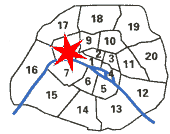
The Gaumont Champs-Elysées
A Souvenir Album
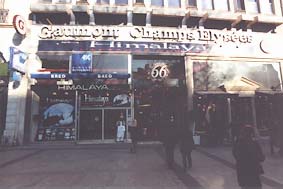
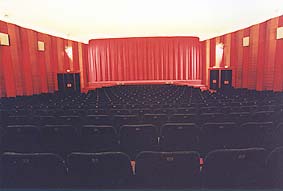
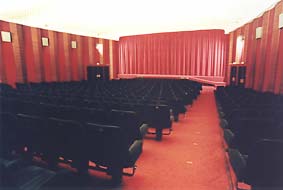
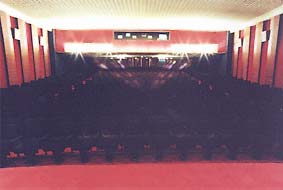
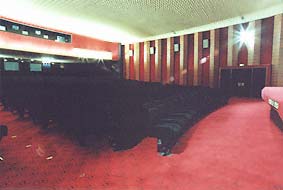
The Gaumont Champs-Elysées was inaugurated in 1971, with Jacques Tati's "Trafic". This luxurious movie theater could accomodate up to five hundred people in its auditorium.
Index
The Gaumont Champs-ElyséesA Souvenir Album
The Gaumont Champs-Elysées was inaugurated in 1971, with Jacques Tati's "Trafic". This luxurious movie theater could accomodate up to five hundred people in its auditorium. |
 |
 |
|
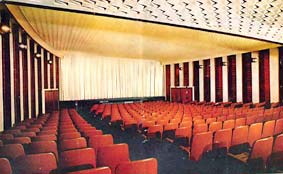
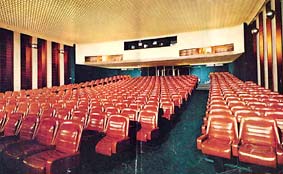
The leather seats were raised on hydraulic jacks (like the France-Elysées); when you seated, you slowly went down (but if you moved during the movie, your seat could go back up).
|
 |
 |
 |
 |
| The Gaumont Champs-Elysées usually played quality and art movies. It often played movies than had won prizes at the Cannes Film Festival. Rumor has it that Woody Allen really enjoyed this theater, and Kubrick had selected it to play "Full Metal Jacket". Its biggest hit was "Four Weddings And A Funeral", which was played for six months. |
 |
 |
| During the 90s, fewer movie theaters closed down than during the 80s, and no-one will complain. But new year's eves have often been fatal to Parisian movie theaters lately, and the Gaumont Champs-Elysées will follow the path of the UGC Biarritz (1994 for theaters 2 through 6), the Publicis Saint-Germain (1995) and the Gaumont les Halles (1998). |
 |
 |
|
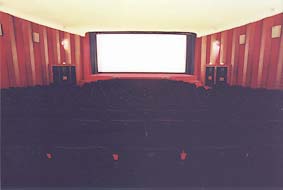
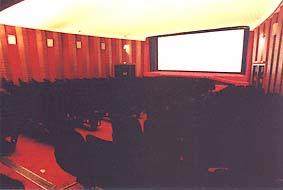
The Gaumont Champs-Elysées was among the first theaters equipped in Dolby Stereo in Paris. Gaumont was very proud of the projection, and the theater has always been the most expensive in Paris, and still being successful. It was the only circuit theater not to have reduced fares for everyone every Monday in the early 80s, a sign in its window actually saying that was because the projection was excellent (I still can't figure out their point!). The theater was also equipped for 70mm, and later Dolby SRD and SDDS sound. The only problem was the 30ft wide screen, which was a bit small for the auditorium, even though the screen was a bit higher for 70mm movies. During fall of 1998, the screen was enlarged, it became 35ft wide (the ceiling prevented anything bigger), and was inaugurated by Robert Redford's "Horse Whisperer".
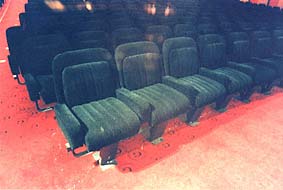 the famous hydraulic seats Usually, movie theaters close down when viewers become scarce, or after a new multiplex is built. This wasn't the case with the Gaumont Champs-Elysées, who had kept most of its audience. This movie theater was the casualty of the war between clothes superstores. Benetton badly wanted this remarkable space, and gave a huge sum of money for it, one that "can't be refused". This is how the former major movie theaters neighborhood could eventually become an annex to the Boulevard Haussmann and its departement stores, crowded during the weekends afternoons, and empty when the night falls. |
 |
 |
|
The Gaumont Champs-Elysées closed down December 31, 1999, after the 3:30pm show, as the Champs-Elysées was getting ready for the false century celebrations, and the UGC Champs-Elysées became the last single-screen movie theater on the famous avenue.
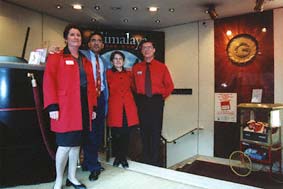
The manager and some of the staff
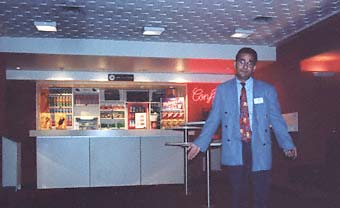
The manager feels deeply regrets the closure...
|
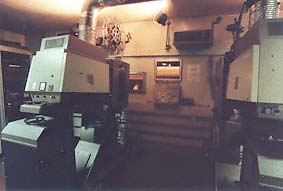
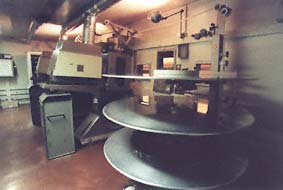
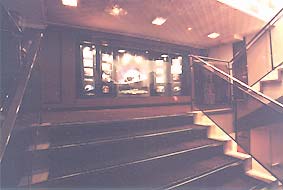
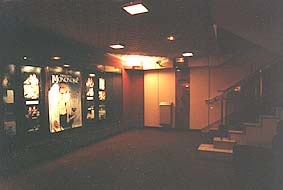
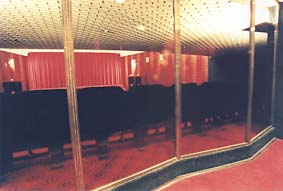 The auditorium go be reached after a long descent, during which two small lobbies could be found. In the first lobby, pictures and posters of movies to come were behind a large window; the projection booth, the restrooms and the offices could also be found on this level. In the second lobby, there was another window and a small concession stand (not the most popular among the costumers who didn't come to eat, but to see the movies). When it was crowded, people could wait in the staircase for the previous show to end. After that, you could open the double doors, and admire the beautiful auditorium behind large windows. (left picture)
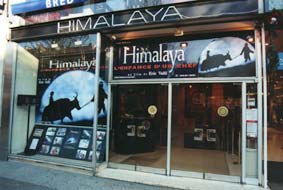 The closure of the Gaumont Champs-Elysées could be a problem for Gaumont, who lost its prestigious Champs-Elysées theater, where it played its best movies. My suggestion would be to play these movies at the Publicis Elysées (once it's been fully renovated, of course); the largest auditorium is pleasant; its volume is similar, and its screen is about as big; the smallest auditorium is more than decent, and would allow to keep the movies for a longer time. It is true that the Publicis, which is near the "Arc De Triomphe" does not have a location as favorable as the Gaumont, but several years back, it could fill its auditoriums without too much trouble; and the UGC George V, right across the Champs-Elysées, sells more than 900,000 tickets every year, which makes it the first movie theater on the avenue, which proves the location can attract moviegoers.